
Last updated September 20, 2026
Free on-site gate assessment - hinges, posts, and your LiftMaster or Nice gate operator checked before anything is quoted
The assessment is free and the quote is the invoice.


 Before
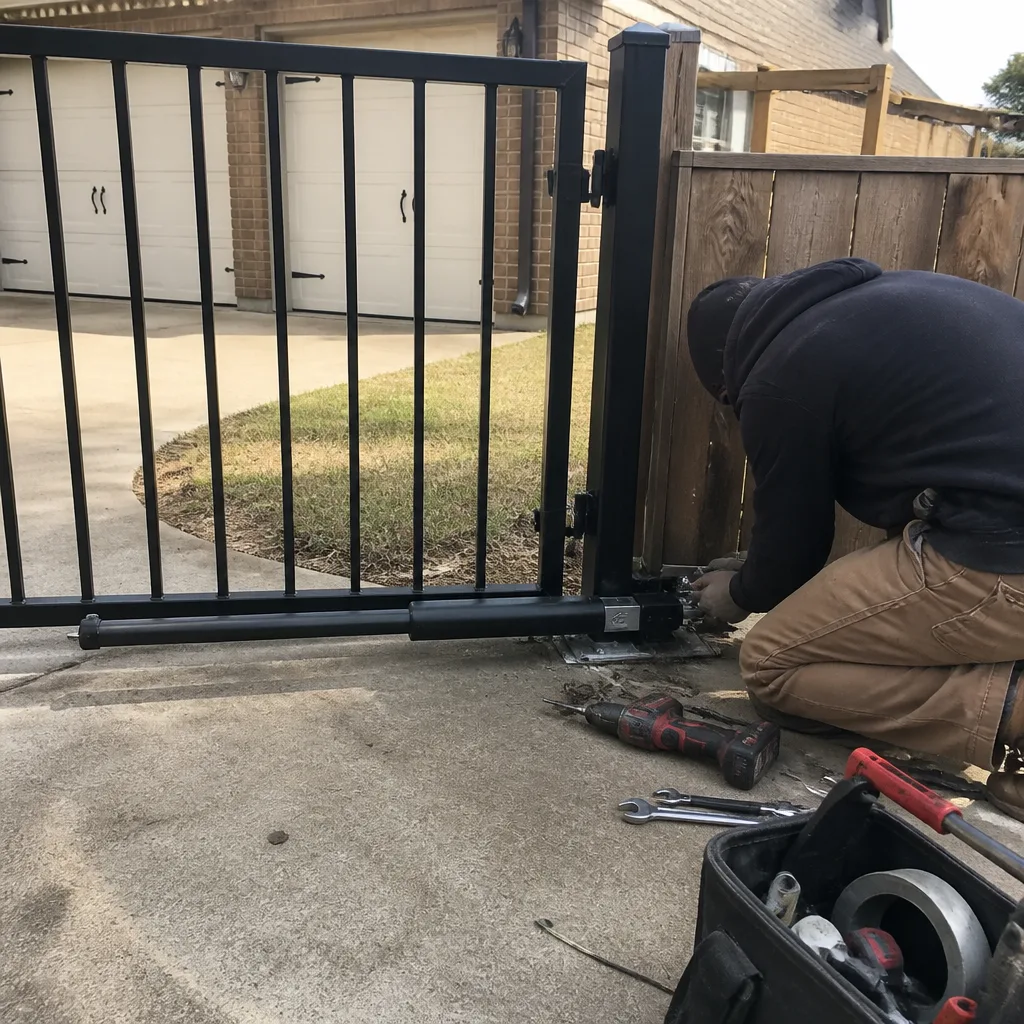 After
After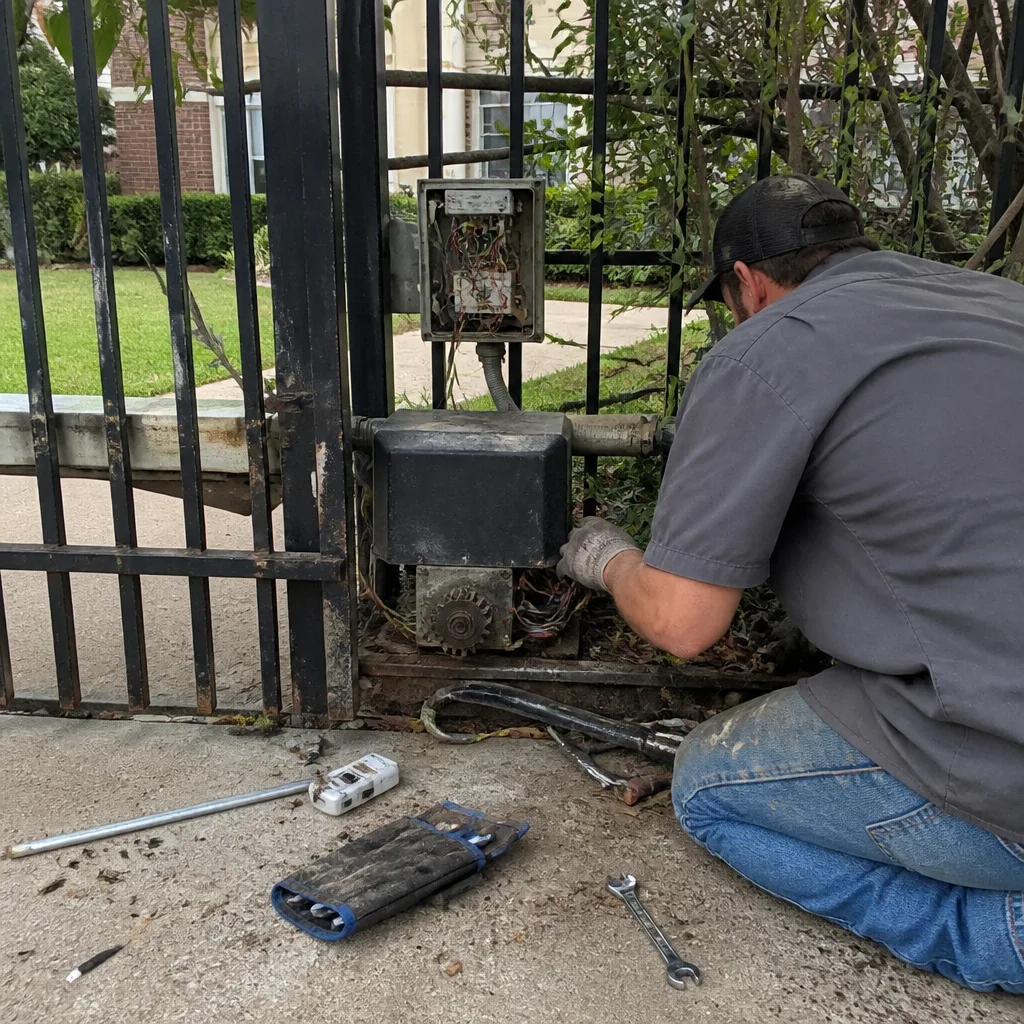 Before
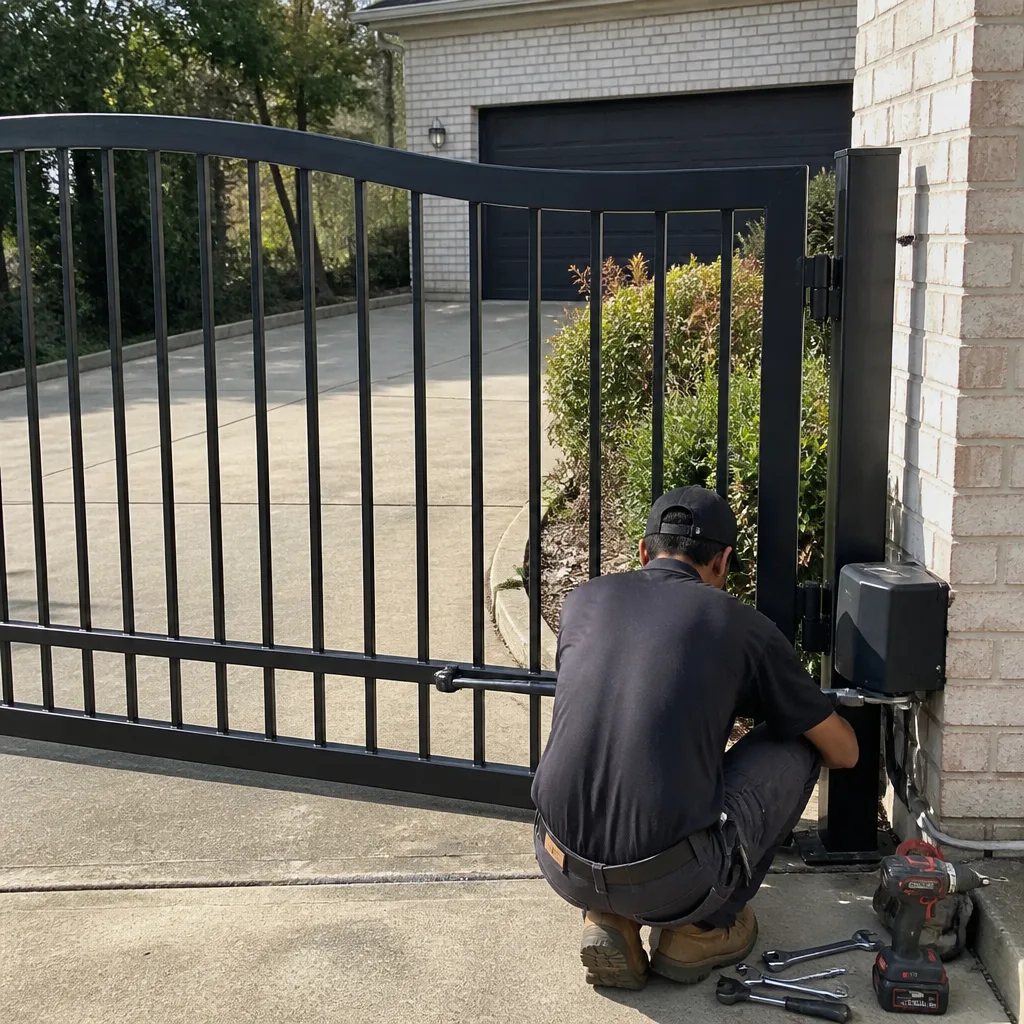 After
After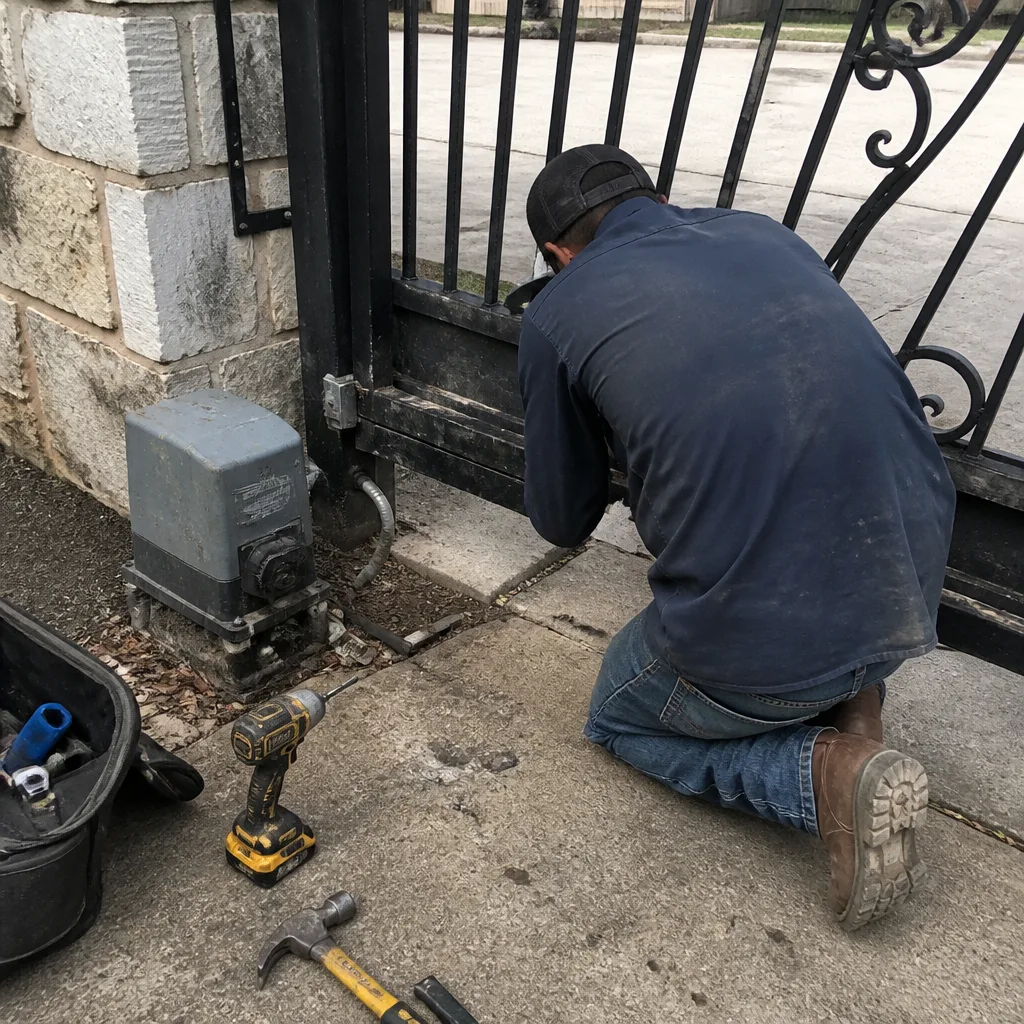 Before
 After
AfterGate Repair Warning Signs: A Mansfield Homeowner’s Reference Guide
A gate that hesitates for two seconds before opening is showing you a motor that’s already working outside its rated load, and most Mansfield homeowners interpret that pause as a quirk rather than a countdown. The two-second delay is the operator drawing more current than it should, which means something in the system is binding, dragging, or fighting the motor. What you do with that information determines whether you spend a few hundred dollars on an adjustment or fourteen hundred on a full motor replacement. This guide sorts gate warning signs by urgency, because a hinge that groans in February and a hinge that groans in August are not the same problem in Mansfield’s clay soil and summer heat. You’ll learn what to stop using immediately, what to book within two weeks, and what you can safely watch through the next maintenance cycle, plus the documentation steps that turn a first technician visit from exploratory into diagnostic.
Quick Answer
Gate repair warning signs in Mansfield fall into three urgency tiers: stop-using-it-now signals (a gate that reverses mid-travel, a motor that hums without moving the gate, visible post lean, sparking or burning smell), schedule-within-two-weeks signals (grinding, hesitation, slow travel, sagging gate leaf), and monitor-at-next-maintenance signals (light surface rust, minor cosmetic wear, slightly stiff manual operation). The single most useful action you can take when any sign appears is to photograph it, note the time and weather, and record whether it happens consistently or intermittently, because that documentation is what separates a fast diagnosis from a paid guessing session.
Table of Contents
- Tier One: Stop Using the Gate Now
- Tier Two: Schedule Within Two Weeks
- Tier Three: Monitor at Next Maintenance
- Electrical Warning Signs You Cannot See
- Misaligned Gate or Moved Post: How to Tell the Difference
- What the Gate Sounds Like: Grinding, Clicking, Humming, and Silence
- The Documentation Step: What to Photograph and Write Down
- Common Mistakes to Avoid
- When to Call a Professional
- Frequently Asked Questions
 Before
 After
AfterTier One: Stop Using the Gate Now
Some warning signs are not requests for maintenance. They are the gate telling you the system has entered a failure state that can cause injury, property damage, or a repair bill that doubles every week you ignore it. In Mansfield, where summer heat pushes operators harder and winter rain shifts the clay under posts, these signals tend to appear after weather events. Here is what means stop using the gate immediately and disconnect or disable the operator until a technician looks at it.
A motor that hums but does not move the gate. The motor is receiving power and trying to turn. Something is mechanically bound: a seized bearing, a snapped internal gear, a chain that has jumped a sprocket, or a gate leaf that has wedged against a shifted post. Every second the motor hums while stalled, it is pulling locked-rotor current through the windings. On a Linear or Viking operator, that is a fast path to burning out the motor entirely. Turn the system off at the breaker or the operator’s power switch and leave it off.
A gate that reverses after hitting the closed position. The operator believes something is obstructing the gate. Sometimes that is a real obstruction, but in Mansfield, it is more often a limit switch that has drifted or a post that has moved enough that the gate leaf now contacts the stop too early. The operator interprets that early contact as an obstruction and reverses. Left alone, this cycle repeats every time the gate closes, and the repeated reversal hammers the operator’s gear train. If you watch your gate close and then bounce back open on its own, stop using the automatic cycle and switch to manual mode if your operator has one.
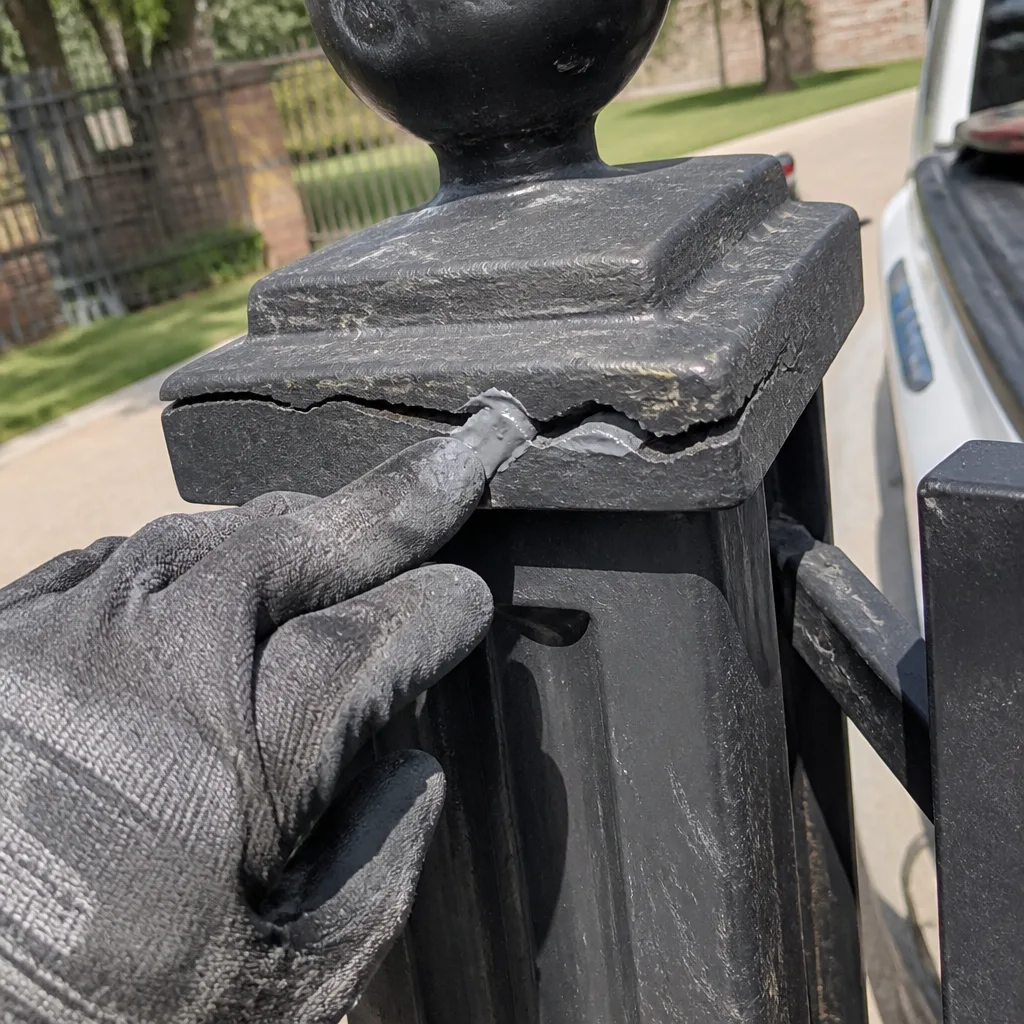
Visible post lean or a gate leaf that has dropped visibly at the latch end. A gate that no longer meets the latch or the mag-lock by a half inch is not a minor adjustment. The post has moved or the hinge hardware is failing. In Mansfield’s expansive clay soil, posts set without adequate concrete depth or drainage shift seasonally, and a post that has moved one inch this year will move more next year. A dropped gate leaf also changes the geometry the operator was set up for, which means the motor is now working against leverage it was never rated for.
Sparking, a burning smell, or a hot control board. Any of these is an immediate power-off situation. Sparking at the operator or the junction box means a short or a loose connection has developed, and a burning smell means insulation is melting somewhere. A hot control board means a component is drawing far more current than it should. In our experience with DoorKing and Ghost Controls boards in the Mansfield area, heat damage is rarely a slow failure. It cascades. Cut power at the breaker, not just at the operator.
None of these four conditions is a wait-and-see item. They are the difference between a repair that costs a few hundred dollars and a replacement that costs four to six times that. If you see any of them, call a gate repair technician before you run the gate again.
Tier Two: Schedule Within Two Weeks
Tier two signals mean the gate is still functional but degrading in a measurable way. You have time to book a service call without an emergency dispatch fee, but not unlimited time. Two weeks is the window during which these problems typically stay cheap to fix. Past that, the wear compounds and the repair cost climbs.
Audible grinding during travel. Grinding is metal on metal. It means a bearing is dry, a chain is run loose, a wheel is dragging through a track groove that has worn sharp, or a gear is chewing into its mate. The sound will not fix itself. It will get louder, and the parts that are grinding will wear until they need replacement rather than adjustment. If you hear grinding on a Mansfield gate, book the call now while the fix is likely still a lubrication, tension, or alignment job.
A gate that hesitates for one to three seconds when you press the remote or keypad. We opened this guide with this one because it is the most commonly dismissed signal in Mansfield. A healthy operator begins travel almost immediately on command. A delay means the motor is struggling against startup load, which points to increased mechanical resistance somewhere in the swing or slide path. The resistance itself might be a dry hinge, a dragging wheel, a track that has shifted, or a leaf that has grown heavy with added pickets or a new privacy screen. The pause is not a personality trait. It is the motor telling you it is working harder than it was designed to work, and that hard work shortens motor life.
Slow travel that has gotten slower over time. Operators are set to a travel speed, and that speed should stay consistent. If your gate used to open in eight seconds and now takes twelve, something is adding load. In slide gates, it is often a track problem or a wheel bearing. In swing gates, it is often a hinge issue or a leaf that is no longer balanced on the post. Sometimes homeowners only notice slow travel in one weather condition: a Mansfield gate that runs slow after a rain event is often telling you about a drainage problem at the track level, not a motor problem.
A gate leaf that sags enough to scrape or catch at the latch post. Scraping at the latch end means the leaf has dropped or the post has tilted slightly. If it is a hinge problem, the fix is often shimming or replacing a hinge. If it is a post problem, the fix is more involved. What matters is that a scraping gate is loading the operator unevenly on every cycle, so the damage is not only at the visible scrape point. It is also inside the operator, accumulating invisibly.
Intermittent failure to respond to the remote, keypad, or vehicle sensor. Intermittent means the system works most of the time and then fails without a pattern you can identify. That randomness is the diagnostic problem, because intermittent failures are the hardest to find. They are also the most common source of repeat service calls nationwide. In Mansfield, where we get wide temperature swings between a cold morning and a hot afternoon, intermittent failures often trace to thermal expansion in a connection, a loop detector that drifts in wet ground, or a receiver that is losing sensitivity. The first visit for an intermittent fault is often the diagnostic visit. The second visit is the repair. If you can document what the gate was doing, what the weather was, and what actually happened, you compress those two visits into one.
Tier Three: Monitor at Next Maintenance
Some warning signs are not urgent at all. They are data points you should note and evaluate at your next scheduled maintenance, which for a Mansfield gate should happen at least once a year, ideally before summer. These signals are worth watching because they can graduate to tier two or tier one, but they do not require a special trip on their own-though our seasonal gate repair care guide for Mansfield explains when to move them up the priority list.
Light surface rust on hinges, brackets, or the gate frame. Surface rust on a Mansfield gate is common, especially on the east side of a property where morning moisture lingers. If the rust is superficial and the metal is still solid, note it. Treat it with a wire brush and a rust converter when you have time, and keep watching. If the rust has begun pitting or flaking, it is tier two, because flaking rust means the structural cross-section of the metal is shrinking.
A gate that sticks slightly when you first try to push it manually. A little initial resistance, especially after a cold night or a wet week, is often just tight hinges or a wheel that has settled. If the gate moves smoothly once it starts, this is a watch item. If the resistance is consistent through the full travel, move it to tier two, because that means the load is constant, not just a startup issue.
Minor rattling during operation. A rattle that does not change pitch or volume and does not correspond with any visible looseness is usually cosmetic. Tighten what you can safely reach. If the rattle becomes a knock or a thump, it has moved to tier two, because a knock means something has developed play that should not be there.
Remote battery warnings or slightly reduced remote range. If your remote only works from thirty feet instead of fifty, start with the battery and then the receiver antenna. These are wear items and they degrade slowly. They belong on the maintenance list, not on an emergency dispatch. That said, if remote range drops suddenly rather than gradually, consider the possibility of a new interference source on your property, such as a recently installed LED fixture, a new wireless camera, or a neighboring gate system. Sudden range loss is not a battery problem.
The discipline here is simple: note the tier three signal, write it down, and check it again at maintenance. If it has worsened, reclassify it. If it has not changed, it stays on the watch list. Most gates give you weeks of notice before a small problem becomes a stopped gate. You just have to be looking.
Electrical Warning Signs You Cannot See
A visual inspection catches mechanical wear, but the most expensive gate failures in Mansfield are electrical, and they happen inside boxes and boards where no amount of looking from the outside will reveal them. These are the warning signs a homeowner cannot see but can still detect through behavior. Understanding them helps you describe the problem accurately when you call a technician, and an accurate description on the phone is the difference between a truck stocked for the right repair and a truck stocked for a guess.
Voltage drop at the board. Gate operators run on specific voltage ranges, and when the supply voltage at the control board drops below that range, the board behavior changes. You might see slow operation, intermittent faults, or a keypad that resets itself. Voltage drop happens for a few reasons in Mansfield: a long wire run from the house to the gate, a connection that has corroded underground, a transformer that is failing, or a breaker that is shared with another load that cycles. The homeowner sees the symptom, not the cause. The technician’s multimeter reads the number, and the number is the diagnosis. Written documentation matters here: when we check voltage on a service call, we write down what we measured and where, so the next visit starts from a baseline rather than a blank sheet.
Intermittent relay clicks without corresponding gate movement. A relay is an electrically operated switch inside the operator. When the control board sends a signal, the relay clicks and the motor circuit closes. If you hear a click but the gate does not move, the relay is engaging but the power is not reaching the motor, or the motor is not responding. That points to a bad relay, a bad motor capacitor, a broken wire, or a board that is sending partial commands. A single click with no movement is not a one-off. It is a circuit failure that will repeat until the component is replaced.
Erratic loop detector behavior. The loop detector is the component that reads the induction loop buried under the driveway and tells the gate to open or stay open when a vehicle is on it. Loop detectors are sensitive to ground moisture, and Mansfield’s clay soil holds water differently than sandy soil does. After heavy rain, a loop that is cracked or poorly sealed can drift out of calibration. The symptom is a gate that opens for no visible reason, refuses to close after a vehicle passes, or stays open with the warning light flashing. Homeowners sometimes assume the gate is possessed. It is not. It is reading a false vehicle presence, and the fix is a loop detector recalibration or a loop repair, not an exorcism.
Transformer hum that changes pitch under load. The transformer steps down house voltage to the operator’s control voltage, and a healthy transformer hums at a steady, low level. If the pitch changes when the gate cycles, the transformer is straining against a load it should not be seeing. That strain means something downstream is drawing too much current: a failing capacitor, a corroded terminal, or a motor winding that is breaking down. The transformer is rarely the root cause. It is the canary. When the canary sings off-key, dig deeper.
What all of these have in common is that they are invisible from the outside and only show up through behavior or through a meter. If your gate is doing something that does not match the weather, the season, or anything you can see, treat the electrical system as the prime suspect and call a technician who will document what they measured. A verbal “we checked the voltage” is not the same as a written number. Get the number.
Misaligned Gate or Moved Post: How to Tell the Difference
A gate that does not close squarely, scrapes at the latch, or sits visibly low at the free end could be misaligned, or the post could have moved. The repair for one is adjustment. The repair for the other is structural. Getting the diagnosis wrong wastes money, because you can align and adjust a gate on a moving post until the operator burns out and the gate still will not be right. Here is how to tell them apart before you pay anyone.
First, look at the gap between the gate leaf and the post at the hinge side. If that gap is consistent from top to bottom, the gate is probably hanging true and the post has not moved in a way that matters. If the gap is wider at the top than at the bottom, or vice versa, the post is leaning or the hinges have failed. A post that leans changes the hinge geometry, and any hinge mounted to a leaning post transmits that lean into the gate leaf’s travel path.
Second, check the gate at the midpoint of its swing or slide. Put the gate at half travel and look at it from the end. A gate that is balanced will hold its line. A gate that droops at the free end is either hinge-worn or the leaf itself has racked, meaning the frame has twisted slightly. If the leaf has racked, no amount of hinge work will fix the hang; the frame needs to be corrected or the leaf replaced.
Third, look at the ground around the post. In Mansfield, post movement is usually a soil problem before it is a hardware problem. Clay soil expands when wet and contracts when dry, and a post set without adequate concrete below the frost line or without drainage will pump up and down through the seasons. If you see a gap opening between the concrete collar and the soil around it, or if the concrete collar itself has cracked on one side, the post is moving. Compare that to a gate that is merely out of adjustment, where the post stays straight and the problem is in the hinges, the operator’s limit settings, or the latch strike.
Fourth, open and close the gate manually and feel the resistance. A misaligned gate drags inconsistently: it binds at one point in the travel and frees up at another. A gate on a moving post often drags consistently, because the entire travel path has shifted relative to the operator and the latch. The feel is different, and once you know what you are feeling for, it is fairly obvious.
If you have any doubt, document what you see with photos and measurements before you call a professional. A photo of the hinge gap, a photo of the concrete collar, and a note about where the gate drags is enough for a technician to start forming a diagnosis before they arrive. And if a technician arrives, looks at the gate for ninety seconds, and starts adjusting the limit switches without checking the post, get a second opinion. In Mansfield, we provide free second opinions on any written estimate from another company, because the wrong diagnosis is more expensive than the second opinion ever was.
What the Gate Sounds Like: Grinding, Clicking, Humming, and Silence
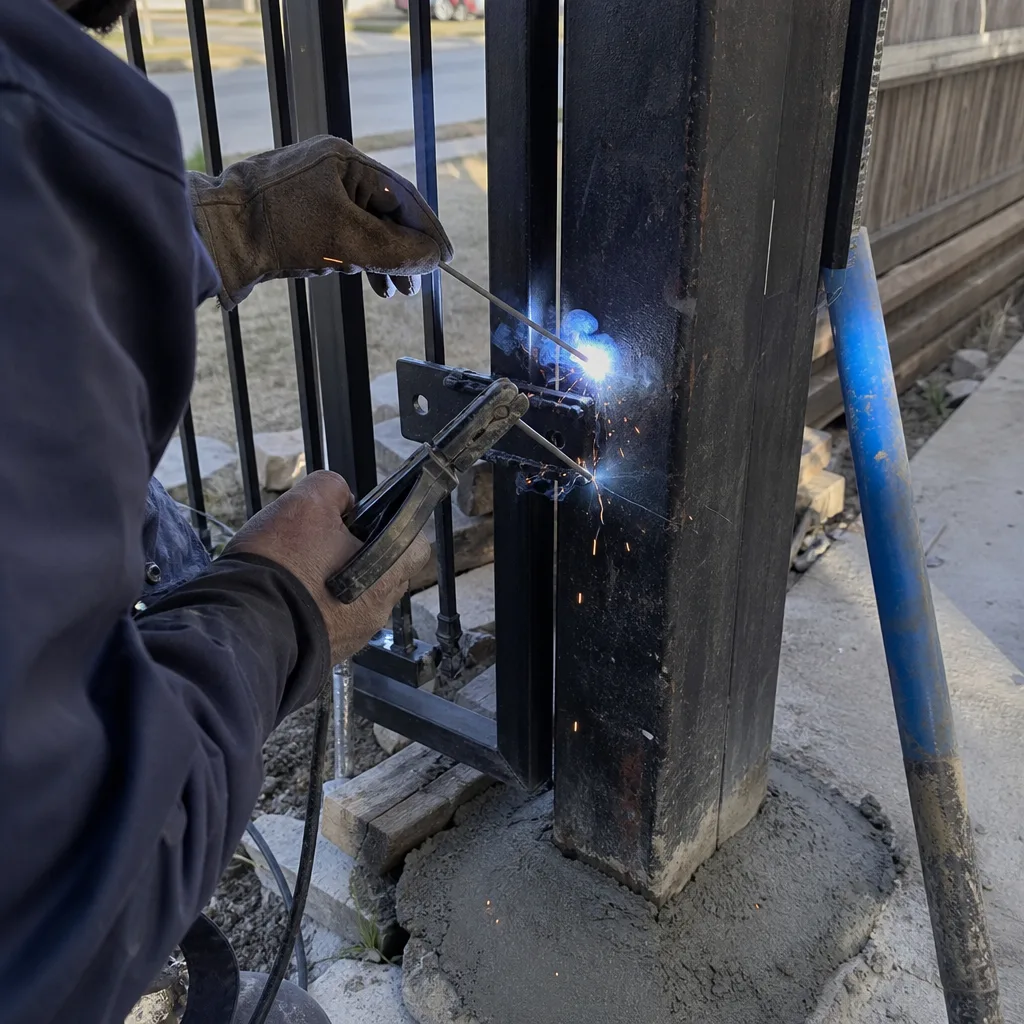
Sound is the most underused diagnostic tool a Mansfield homeowner has, because the gate is already telling you what is wrong. You just need to know what each sound means. Here is the short field guide, based on what we hear most often on service calls across Mansfield.
Grinding. A grinding sound is metal on metal with load behind it. It means a bearing is dry or shot, a chain is dragging across a guide, a wheel is running through a deformation in the track, or a gear is wearing against its mate. Grinding is directional: if the sound appears only when the gate opens but not when it closes, the problem is on one side of the load path. Note the direction. It narrows the technician’s hunt immediately.
Clicking. A single loud click when the gate starts or stops is often a limit switch engaging or a relay closing, and on many operators, a single click at the end of travel is normal. Multiple rapid clicks during travel are not normal. They indicate a relay chattering, which means a control voltage problem, a loose connection, or a board that is trying and failing to hold a circuit closed. A click followed by nothing means a relay is engaging but the motor is not receiving power. All of these are electrical, and all of them are cheaper to fix before the component in question burns out completely.
Humming. A steady low hum is the transformer and the motor at idle, and it is normal within reason. A hum that grows louder when the gate is asked to move but no movement happens is the stalled-motor sound we covered in tier one: shut it down. A hum that changes pitch mid-cycle means the load on the motor is varying, which points back to a mechanical bind somewhere. On a Viking or Linear operator, a stalled motor can also trip the thermal overload, which shuts the gate down until it cools. If your gate stops mid-cycle and starts again twenty minutes later, that is the thermal overload doing its job, and the underlying bind is the problem to fix.
Silence. A gate that stops responding entirely, with no click and no hum, is usually a power or control input problem. Check the breaker first. Check that the operator’s power switch has not been turned off. Check the keypad or remote battery. If all of those are good and the gate is still silent, the problem is likely upstream: a failed transformer, a blown fuse on the board, a broken wire between the house and the gate, or a control board that has lost input power. Silence is the easiest symptom to describe and sometimes the hardest to trace, because the failure point can be anywhere along the wire run. A technician with a meter will find it. A homeowner with a screwdriver may not, and the chance of poking into a live control board is not worth the saved service call.
One habit worth building: when the gate makes a sound you have not heard before, record it on your phone. A ten-second audio clip attached to a service request is genuinely useful, because it lets the technician hear the sound before they arrive and often identifies the problem class immediately. We receive these from Mansfield homeowners regularly, and they shorten the diagnostic step every time.
The Documentation Step: What to Photograph and Write Down
The moment a warning sign appears, you should start a paper trail. Not because the gate company does not believe you, but because the information you capture in the first hours after a symptom appears is information that may not be reproducible later. Intermittent faults disappear when the weather changes. Sounds stop. The gate works perfectly the day the technician visits, and everyone stands around looking at a gate that refuses to misbehave. Documentation is what keeps that visit from being a wasted trip charge.
Here is what to record, step by step:
- Photograph the symptom. If the gate sags, photograph it from the end so the droop is visible. If it scrapes, photograph the scrape mark and the point of contact. If a post has a cracked concrete collar, photograph the crack with a coin or a key in the frame for scale. Wide shots and close shots. The wide shot shows context; the close shot shows the actual condition.
- Photograph the operator and the board. Take a clear photo of the operator’s brand and model label, and if you are comfortable opening the cover, a photo of the control board. The model number tells the technician which manual to bring mentally, and the board photo sometimes shows a blown fuse, a scorched trace, or a diagnostic LED that is already communicating the fault code.
- Write down the time, weather, and what happened. “Gate reversed on close, 7:40 a.m., 42 degrees, after rain overnight” is a far better note than “gate acted weird.” Weather matters in Mansfield because the clay soil and the temperature swings both affect gate behavior. The day, time, and conditions are the context that turns a symptom into a diagnosis.
- Test and record consistency. Run the gate three times and write down what happens each time. Does it fail every time, or once in three? Does it fail at the same point in travel, or at random points? Consistency versus randomness is one of the most useful pieces of diagnostic information there is.
- Note anything that changed recently. New landscaping, a new fence section, a new gate opener remote, new lights on the driveway, a storm that washed soil away from a post. Change events are diagnostic clues. Gates do not usually break without a cause; the cause is often the thing that changed.
- Keep the record. A folder on your phone or a note in a notebook works fine. The point is that when you call a gate company, you can describe the problem precisely, and the technician arrives with a working hypothesis instead of a blank slate.
This documentation habit is exactly what we built our service model around. Every Vance Gate Repair Mansfield visit includes a documented photo record of what was found, what was adjusted, and what was replaced. Homeowners who keep their own records make our job faster, and a faster diagnosis is a cheaper diagnosis. For more guides & resources on gate maintenance and troubleshooting, visit our blog.
Common Mistakes to Avoid
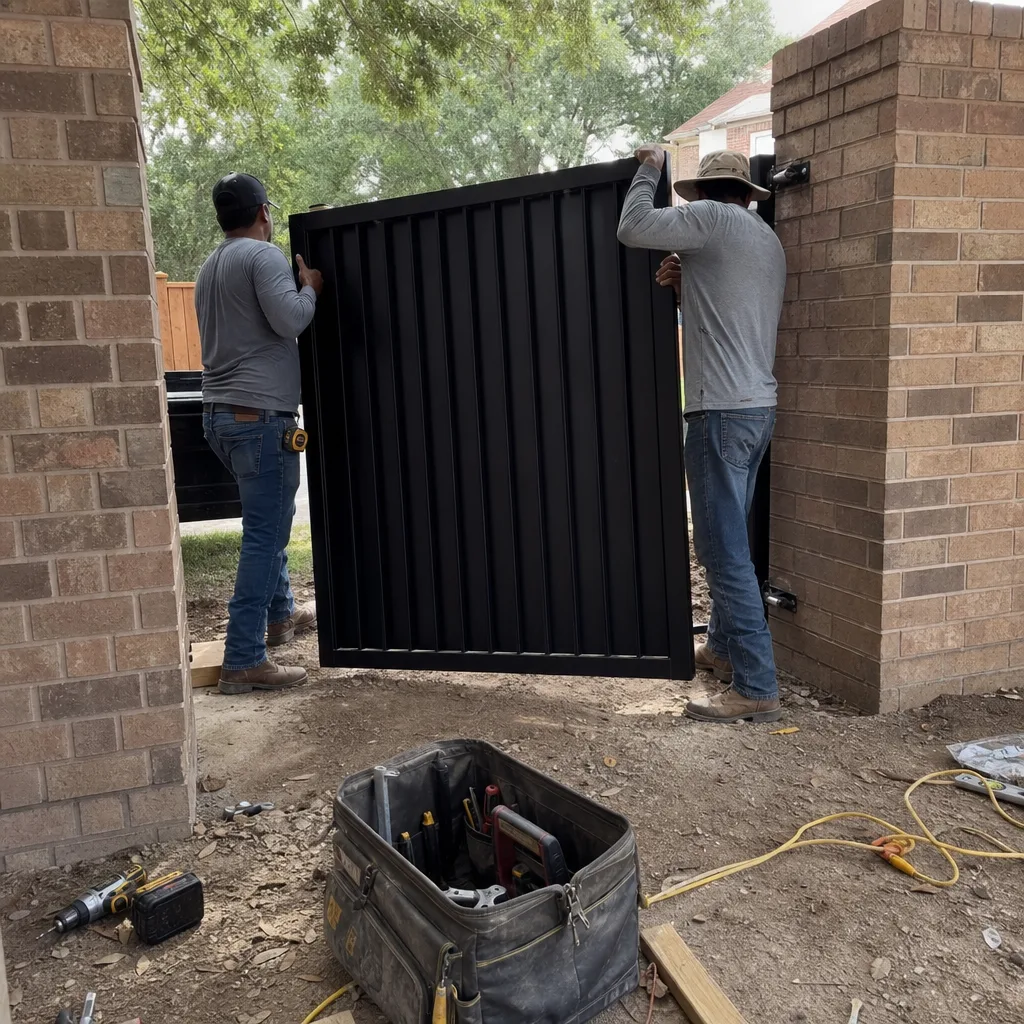
- Running the gate after a tier-one signal to “see if it is still doing it.” A gate that has reversed on close, hummed without moving, or shown sparking is not going to heal itself. Every additional cycle adds wear to the operator and increases the chance that a repairable condition becomes a replacement condition. Power it down and leave it down until a technician arrives.
- Assuming the operator is the problem. Many Mansfield homeowners replace a motor when the actual problem is a hinge, a wheel, a track, or a post. Operators are often the symptom, not the cause. Before you spend fourteen hundred on a motor, verify that the mechanical system the motor drives is sound, because a new motor on a binding gate will burn out just like the old one did.
- Ignoring sounds because the gate still works. The gate will keep working right up until it does not, and the sounds are the warning that the working period is ending. Grinding, clicking, and hesitation are all cheaper to fix while the gate still cycles than after the failure is complete.
- Lubricating without diagnosing. Spraying lubricant on a grinding gate will quiet the sound for a while, and if the underlying problem is a dry bearing, that is a fine fix. But if the grind is a wheel running through a deformed track or a gear wearing out, the lubricant only masks the symptom while the wear continues. Diagnose first, lubricate second.
- Adjusting limit switches yourself without understanding what they control. Limit switches tell the operator when to stop, and mis-setting them can cause the gate to over-travel and hit the end stops hard, or under-travel and never fully close. On operators with safety devices, a badly set limit can also defeat the entrapment protection. This is a measured adjustment, not a guess.
- Deleting the documentation. Homeowners sometimes delete photos and notes once the gates starts working again, assuming the problem resolved. Intermittent problems recur. Keep the record. The next time the symptom appears, the technician will want to know it is a repeat performance, not a first appearance.
- Waiting until the gate fails completely to call. A stopped gate in Mansfield is usually a repair that has been announcing itself for weeks. The hesitations, the grinds, the sags: all of them were telling you something. The homeowners who catch the signal at tier two spend a few hundred dollars. The ones who wait for tier zero spend a lot more and get to remove their gate from the track manually while they wait for a truck.
When to Call a Professional
Call a gate professional when any tier-one signal appears, when a tier-two signal has persisted for more than a week without improvement, or when the gate is doing something intermittent that you cannot reproduce on command. Also call when the problem is electrical in nature: any clicking, humming, failure to respond, or board behavior that you cannot trace to a battery or a breaker is a job for a meter and a trained eye, not a homeowner with a flashlight. Gate Repair in Mansfield is what we do, and we do it with a written price handed over before any work starts. Vance Gate Repair Mansfield home offers free estimates in Mansfield, call (682) 564-0512 and a live person answers, day or night. Take your photos, write your notes, and bring the gate’s paper trail with you; the first visit will be diagnostic, not exploratory.
Frequently Asked Questions
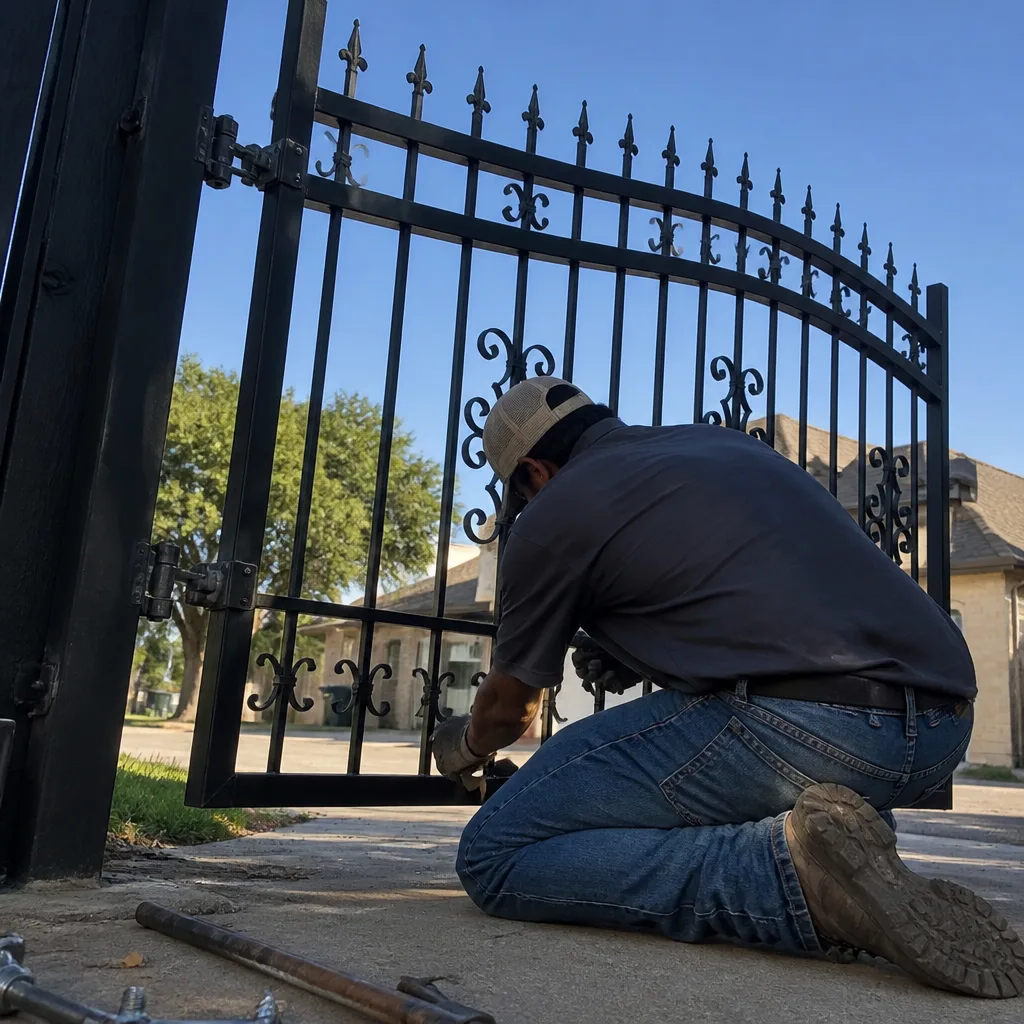
Gate repair in Mansfield typically runs between $150 and $600 for most mechanical adjustments and minor electrical work, while motor replacements, board replacements, and structural post work run higher, often between $800 and $2,500 depending on the operator brand and the condition of the surrounding hardware. The spread exists because “gate repair” covers everything from a limit switch adjustment to a full operator swap with new safety edges. Under our process, you get a written price before any work begins, so the number is never a surprise. Call (682) 564-0512 for a free estimate on your specific gate.
Yes, for tier-one emergencies such as a gate stuck open, a stalled motor, or a gate that will not close, we dispatch same-day service in Mansfield, and a live person answers the phone 24 hours a day to take the call. For non-emergency work, we schedule within the week, which is plenty fast enough for a tier-two grinding hinge or a slow-traveling operator. The phone number is (682) 564-0512.
A full Gate Installation in Mansfield includes the gate leaf or leaves, posts set in concrete to the correct depth for Mansfield’s clay soil, hinges or track hardware, the operator, safety devices, and the electrical run from the house. What it should also include, and what we always provide, is a written scope of work, a written price before the job starts, and a photo record of what was installed and how it was set. Get the details at the link above.
Yes, Gate Motor & Opener in Mansfield covers nine major automation brands including LiftMaster, FAAC, BFT, Linear, Viking, Ghost Controls, DoorKing, Elite, and Mighty Mule. We do not steer you toward replacing an operator just because it is not the brand we sell most; we service what is on the property and tell you honestly whether repair or replacement makes more financial sense.
Look for a wider gap on one side of the hinge post than the other, a cracked concrete collar around the post, a gap between the collar and the surrounding soil, or a gate that drags consistently through its entire travel rather than binding at one point. Mansfield’s clay soil expands and contracts with moisture, and posts that were not set deep enough or with proper drainage move seasonally. If you see these signs, the fix is structural, not just an operator adjustment.
Photograph the symptom, note the time and weather, test the gate three times and record what happens each time, and write down anything that changed recently on the property. That documentation turns the first technician visit into a focused diagnostic call instead of a paid exploration, and it is exactly the kind of record we create for every customer under our process. Then call (682) 564-0512 and describe what you found.
The Bottom Line
Gate warning signs are not random. They are the system’s way of reporting its condition, and the only question is whether you are listening. A gate that hesitates is a motor under load. A gate that grinds is metal wearing. A gate that reverses is a limit switch or a post that has moved. Sort what you see and hear into the three tiers in this guide, act immediately on tier one, book within two weeks on tier two, and write down tier three so you can catch it if it worsens. Photograph everything, keep the record, and call a professional before the gate makes the decision for you. In Mansfield, the clay soil and the summer heat are working against your gate every year. The homeowners who stay ahead of it spend less, and the ones who do not replace motors that never should have died.
Written by Adrian Vance, Owner at Vance Gate Repair Mansfield, serving Mansfield since 2014.